Prebuilt Cabinets: Warranty and Spare Parts
A one-year warranty sounds thin until you read what it covers and what actually breaks. CasaBuilt's policy runs for one year against manufacturing defects in materials and workmanship under normal residential use, and the cabinet it protects is a 1/2-inch birch plywood box with a 3/4-inch solid birch face frame, soft-close hinges and dovetail drawers. The realistic question is not how long the paper lasts but which parts you will need in year two.
Key takeaways
- The warranty covers manufacturing defects in materials and workmanship for one year under normal residential use.
- Hinges are concealed, soft-close and six-way adjustable, so many door problems are adjusted rather than replaced.
- Drawers are 5/8-inch rubberwood with dovetail joints; shelves are 3/4-inch adjustable plywood.
- Inside a six-cabinet bundle, the published per-cabinet price ranges from $197.49 to $322.07 across four styles.
What the one-year window actually covers
The policy is specific: defects in materials and workmanship, under normal residential use, for one year. It is a manufacturing promise, not a maintenance contract. A drawer that delaminates at the joint, a hinge plate that will not hold adjustment, a door panel that has moved in a way the factory should have prevented — those are the cases the policy is written for.
Everything the installation touches falls outside it. A screw driven through the side of a cabinet, a run fixed to a wall that is not straight, a door over-tightened until the frame cracks: none of those are defects in materials or workmanship. CasaBuilt's own warranty policy sets the scope, and reading it before installation is far cheaper than reading it after.
The year starts from a fixed point and runs once. That is worth saying plainly because the phrase "one-year warranty" is often heard as a floor rather than a ceiling. There is no second window, and the support route after the window closes is a part order rather than a claim. Buyers who expect a decade of coverage will be disappointed by the calendar; buyers who expect a responsive first year usually are not.
Reading the hardware spec as a repair manual
The specification page tells you what will need attention. CasaBuilt lists concealed, soft-close hinges with six-way adjustment. Six-way adjustment is the important phrase: it means the door sits on a plate that can move in and out, left and right, and up and down, plus the tilt that closes the gap at the top corner. A door that has dropped after a humid summer is usually a two-minute correction with a screwdriver, not a warranty event.
The glides are soft-close and undermount, running full extension. Undermount glides sit under the drawer box rather than on its sides, which keeps the drawer interior clear and puts the mechanism out of the way of spilled flour. When a drawer starts to close hard, the first check is whether something has dropped into the glide track, not whether the glide has failed.
The drawers themselves are 5/8-inch rubberwood with dovetail joints, and the shelves are 3/4-inch adjustable plywood with a half-depth shelf in base cabinets. Dovetail joints are the reason a drawer box rarely appears in a claim: the joint is interlocking, so it fails by crushing rather than by pulling apart cleanly. Adjustable shelves mean a missing or damaged shelf is a part request, not a cabinet replacement, because the cabinet does not depend on that one board for its structure.
Assembly matters here too. The collection is sold in two forms, and prebuilt cabinets remove the step where most damage happens, because nobody drives a screw into the wrong pilot hole at the kitchen table. Flat-packed cabinets are not fragile, but they depend on the builder following the guide, and a cam that is over-tightened is an installation error rather than a manufacturing defect.
What a claim needs from the buyer
A claim moves at the speed of its evidence. The buyer who writes "the door is broken" starts a correspondence. The buyer who writes the order number, the cabinet code, the position in the run and three photographs starts a replacement. Cabinet codes exist for exactly this reason: an oven cabinet, for example, is listed as SWOO338424, which encodes a 33-inch width, an 84-inch height and a 24-inch depth in one string.
Photograph the fault, then photograph the whole cabinet, then photograph the label if there is one. Support needs to identify the part and the finish, and a close-up of a hinge screw tells them less than a wide shot of the door plus a close-up of the plate. The finish matters because a replacement door has to match a run that was painted in the same batch.
Expect a part or a solution rather than a refund. The published wording is that support provides a replacement part or an appropriate solution, which is the normal shape of a cabinet warranty. It also tells the buyer what to ask for: name the part, describe the fault, and let support decide whether the answer is a hinge, a door or something else. A claim that arrives with a diagnosis tends to resolve faster than one that arrives with a complaint.
Spare parts against a replacement cabinet
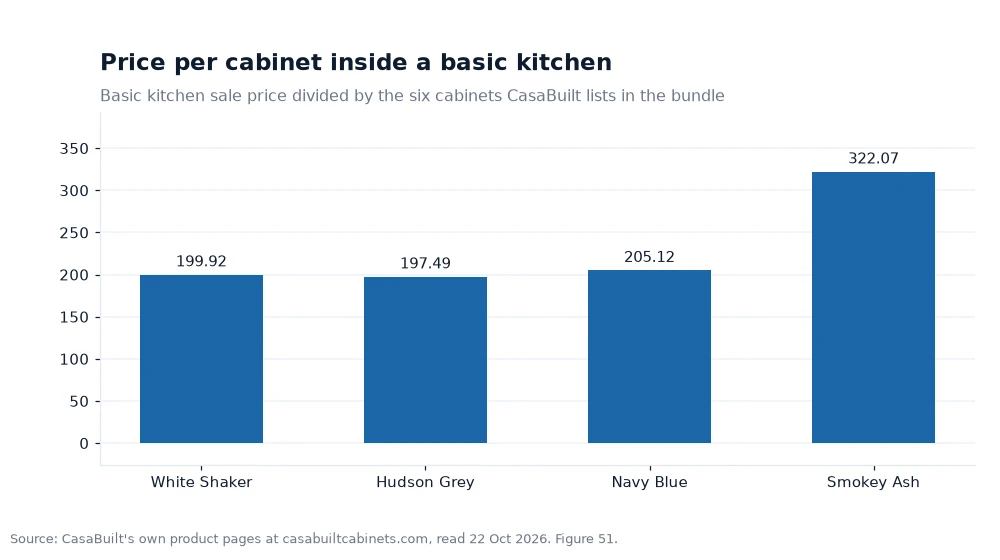
The reason a one-year defect policy is workable is that almost nothing on a cabinet is priced like a cabinet. The chart below takes the basic six-cabinet bundle and divides each published sale price by six, which gives the value of a single cabinet inside the bundle. It is the right number to hold in mind when a part fails: a hinge is not a fraction of a kitchen, but a replaced cabinet is.
| Style | Bundle sale price | List price | Price per cabinet | Discount shown |
|---|---|---|---|---|
| Hudson Grey Shaker | $1,184.93 | $2,369.86 | $197.49 | 50% |
| White Shaker | $1,199.50 | $2,399.00 | $199.92 | 50% |
| Navy Blue Shaker | $1,230.69 | $2,461.37 | $205.12 | 50% |
| Smokey Ash Shaker | $1,932.42 | $2,415.52 | $322.07 | 20% |
The last column explains why the per-cabinet figure moves so much between styles that look similar in a photograph. Two of the four lines are discounted by half and one by a fifth, so the price gap is partly a finish difference and partly a promotion difference. A buyer comparing a replacement cost against a repair should use the price they actually paid, not the list figure, because the replacement is bought at whatever the sale price happens to be on the day.
Worked example: six cabinets, four prices
The chart gives four per-cabinet values: White Shaker $199.92, Hudson Grey $197.49, Navy Blue $205.12 and Smokey Ash $322.07. Multiply each by six to return to the bundle. White Shaker gives $1,199.52 against a published $1,199.50, Hudson Grey gives $1,184.94 against $1,184.93, Navy Blue gives $1,230.72 against $1,230.69, and Smokey Ash gives $1,932.42 exactly. The small differences are rounding in the division, not pricing errors.
Now look at the spread. The cheapest cabinet in the chart, Hudson Grey at $197.49, sits $124.58 below the dearest, Smokey Ash at $322.07. Across six cabinets that is $747.48, which matches the $747.49 gap between the two published bundles once the rounding is restored. As a ratio, $322.07 divided by $197.49 is 1.63, so the Smokey Ash cabinet carries 63% more value per unit than the Hudson Grey one.
Average the four per-cabinet prices and the single-cabinet exposure becomes obvious. The four values sum to $924.60, which divides by four to $231.15. That is what one cabinet is worth in this comparison — roughly the price of an entry-level power tool, and far more than any hardware component inside it. The warranty matters less for the money than for the fact that a cracked hinge plate can be solved without touching that number.
Frequently asked questions
Does the one-year warranty cover installation damage?
No. The policy covers manufacturing defects in materials and workmanship under normal residential use. A screw through a cabinet side, a door over-tightened until the frame splits or a cabinet dropped during fitting is installation damage. Report transit damage before signing the delivery receipt and keep installation errors out of the claim queue.
Can I buy a single replacement door or hinge later?
Support handles replacement parts and appropriate solutions for defects within the one-year window, and the cabinet codes on each listing identify width, height and depth so a part can be matched to the run. Outside the window the same support channel is the place to ask about a part rather than assume none exists.
What should I check when the cabinets arrive?
Open every carton, confirm the count against the packing list, and look at door edges, drawer fronts and hinge plates before the boxes go into storage. Photograph anything that looks wrong while the packaging is still intact. A fault found on delivery day is simple to describe; the same fault found after three weeks in a garage is harder to attribute.
Keep the paperwork with the kitchen
Photograph the order confirmation and the cabinet labels, and keep both in the same folder as the measurements and the design. Then walk the finished kitchen once with a screwdriver and adjust any door that does not sit flat, because most of what looks like a defect in the first week is a hinge that was never set. The parts that remain a genuine problem are few, and they are the ones the first year is designed to catch.
Figures quoted here come from the manufacturer's own website, read 22 Oct 2026[1].