What OEM Perfume Manufacturing in China Actually Costs
In an OEM perfume project in China, five line items decide almost the entire price: the concentrate, the bottle, the closure, the carton and the filling labour. Concentrate and packaging scale with volume and are largely fixed by your specification, while tooling, development and testing are one-off charges that look small per unit on a large order and alarming on a small one. Buyers who compare quotes without separating those two groups are comparing arithmetic, not suppliers.
Key takeaways
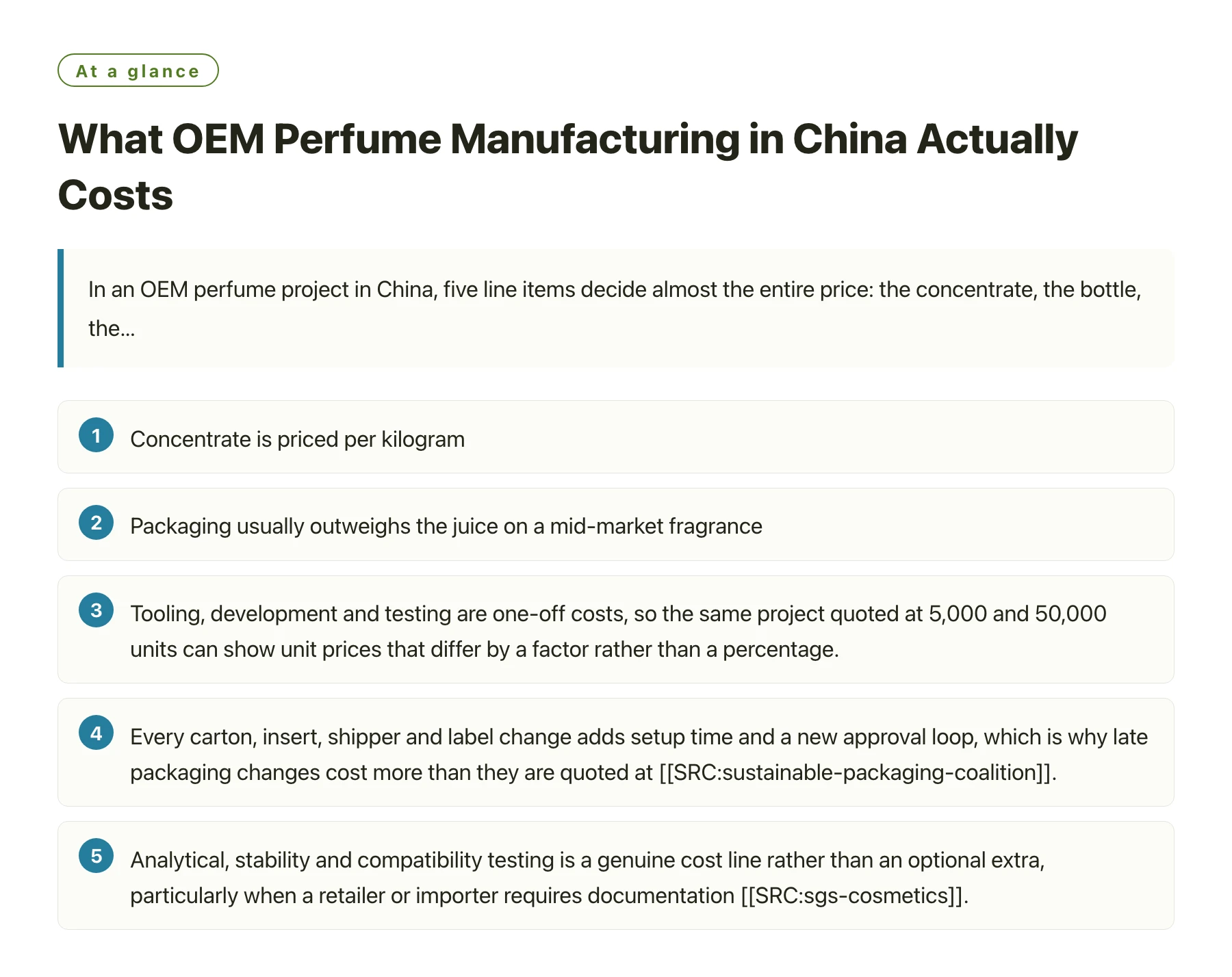
- Concentrate is priced per kilogram, so its contribution to unit cost falls as volume rises but never disappears; juice at a higher concentration costs more in direct proportion.
- Packaging usually outweighs the juice on a mid-market fragrance, which is why bottle weight, glass thickness and decoration choices move the total more than most buyers expect.
- Tooling, development and testing are one-off costs, so the same project quoted at 5,000 and 50,000 units can show unit prices that differ by a factor rather than a percentage.
- Every carton, insert, shipper and label change adds setup time and a new approval loop, which is why late packaging changes cost more than they are quoted at [1].
- Analytical, stability and compatibility testing is a genuine cost line rather than an optional extra, particularly when a retailer or importer requires documentation [2].
Founders usually ask for a unit price first, and get one, and then discover that the number cannot be compared to anything. A per-unit figure is the output of a dozen decisions: alcohol grade, concentration, glass weight, pump type, decoration method, carton stock, fill volume and order quantity.
The useful approach is to separate the quote into costs that scale with volume and costs that do not. Once that split is visible, negotiation becomes specific — you are no longer arguing about a total, you are choosing between a lighter bottle and a heavier one, or between a stock pump and a custom one.
The five lines that decide the price
| Cost line | What drives it | How it behaves with volume |
|---|---|---|
| Concentrate | Concentration percentage, material cost, whether the accord is bespoke or from a library | Falls per unit as volume rises, but the per-kilogram price barely moves |
| Bottle and glass | Weight, mould type, colour, whether the shape is standard or new | Stock shapes fall sharply per unit; a new mould does not |
| Closure and pump | Crimp or screw, dosage, actuator finish, whether parts are stock or custom | Stock parts fall slowly; custom parts carry tooling |
| Secondary packaging | Carton stock, printing method, inserts, shippers, label stock | Print setup is amortised across the run, so short runs are penalised |
| Filling and assembly | Line time, decoration steps, number of components, hand work | Falls per unit, but only down to the line's practical minimum |
| One-off charges | Development, tooling, artwork preparation, testing, sampling | Divided by volume, which is why small orders look expensive per unit |
If a supplier cannot split its quote along these lines, that is a more useful signal than any single number in it.
Why packaging moves the total more than the juice
It is common to assume that the scent is the expensive part of a fragrance. On a mass-market body mist it often is not. Glass, a pump, a cap and a printed carton can together exceed the liquid cost, and each element has its own minimum order quantity. A heavier flacon does not just cost more per unit; it also needs a bigger shipper and a sturdier insert, so the increase compounds through the packaging chain.
This is why cost reduction conversations usually go better when they start at the bottle rather than the formula. Moving from a bespoke mould to a stock flacon, or from a two-piece cap to a single-material one, can change the total more than renegotiating the concentrate — with far less risk to the product itself.
Packaging decisions also carry obligations that outlast the invoice. Design guidance from industry groups such as the Sustainable Packaging Coalition reflects a direction of travel that retailers increasingly encode into their supplier requirements, so a choice that saves a few cents per unit today may need revisiting when a listing is renewed [1].
Decoration is where quotes quietly diverge
Two suppliers can quote the same bottle at the same glass price and still differ substantially, because decoration is priced differently — per colour, per pass, per unit, or absorbed into a minimum order. Ask for decoration as a separate line with the method named: screen printing, hot stamping, spraying, labelling and sleeve all have different setup costs and different failure modes. A supplier set up as fragrance manufacturing under one roof can usually price decoration from its own line records, which is a better basis for comparison than an estimate.
Testing and documentation are line items, not favours
Compatibility testing between the concentrate and the pack, stability checks over time, and analytical verification of the batch all consume laboratory time. Third-party laboratories publish the scope of cosmetic and personal care testing they offer, which is a reasonable way to see what a complete documentation pack contains before you ask a supplier to price one [2]. Buyers who treat these as optional usually pay for them later, as a delayed launch.
Reading the cost structure behind the search term
Quotes become comparable only once you look at the cost structure behind the label perfume manufacturer China, because that phrase describes a sourcing route rather than a single kind of supplier. A trading company, an integrated plant and a development studio will all answer the same brief, and their quotes will allocate the same work to different lines — one may absorb development into a higher unit price, another may bill it upfront and then quote lower per unit.
The practical fix is to send every candidate the same written brief with the same assumptions: fill volume, concentration, pack specification, quantity, and a request for the quote in the six lines above, with one-off charges listed separately. When the responses come back in the same shape, the differences become real differences.
What a factory quote leaves out
It also helps to know what the quote is not. Freight, duties, warehousing, artwork design and any reformulation after approval are usually outside a factory quote, and the assumptions buried in a total — what fill weight was used, what waste allowance was applied, what the minimum run is — are frequently what where a perfume quote can hide costs in the first place. A supplier that states its exclusions explicitly is easier to compare than one that simply quotes lower.
Exclusions are worth writing into the comparison sheet next to the price, because two quotes that differ by ten per cent rarely differ by ten per cent once their assumptions are lined up.
A useful rule when comparing two quotes: match the specification before matching the total. If one quote assumes 12% concentrate and the other 18%, or one assumes a 50ml flacon and the other 30ml, the price difference is measuring the brief, not the factory.
Where the small-order premium really sits
Founders often read a high unit price on a small order as a sign of an expensive supplier. More often it is the one-off costs spread over very few units, plus minimum order quantities on components that cannot be bought in smaller batches. A 3,000-unit run of a custom flacon can cost more per unit than a 30,000-unit run of a stock one, and no amount of negotiation changes the arithmetic.
The commercial question is therefore not how to get the cheapest small order, but how to keep the first order small without paying permanent costs. Stock components, a stock carton and a clearly defined path to a second, larger order do most of that work. Where a supplier's own documentation is public — as with Xuelei on a manufacturer's own site — it also becomes easier to check whether the quality system behind a cheap first quote is the same one that will handle the larger run.
One more line deserves attention before signing: the price of change. A late bottle substitution, a new cap or a revised carton can trigger tooling, sampling and re-approval, and those costs are rarely visible in the original quote. Asking what a mid-project packaging change would cost is one of the most informative questions a buyer can put to a supplier, because the answer describes the process rather than the price. Trade coverage of formulation and manufacturing keeps returning to the same theme, that the visible cost of a product is a small part of the cost of changing it [3].
Sources
- Sustainable Packaging Coalition —— A membership organisation working on more sustainable packaging design, publishing material and recyclability guidance.
- SGS: Cosmetics, Personal Care & Household Testing —— Testing, inspection and certification services for cosmetics and personal care, including microbiological, stability and safety testing aligned with cosmetics GMP.
- Cosmetics & Toiletries —— A technical magazine for cosmetic formulators, covering ingredients, formulation science and testing methods.
Frequently asked questions
Why did my unit price not fall when I doubled the order?
Because the cost lines behave differently. Concentrate and glass fall per unit, but if the quote is dominated by a custom mould or a printing setup, doubling a small volume may not cross the threshold at which those charges amortise meaningfully. Ask for the quote split into scaling and one-off lines.
Is a higher concentration always more expensive?
It raises the concentrate cost roughly in proportion to the increase, assuming the same formula. Whether that shows up in the unit price depends on how much of the total the juice represents. On a premium fragrance in a heavy flacon it is a small share; on a simple body product in a light bottle it can dominate.
Should I buy packaging locally instead of through the factory?
Sometimes. Buying separately can reduce cost if you have the volume and the sourcing capability, but it adds coordination risk: compatibility, timing, and who is responsible when a component arrives out of specification. Consolidating through one supplier usually costs a little more and fails less often.
What is usually missing from a factory quote?
Freight and duties, warehousing, artwork design, third-party testing if not requested, and any reformulation after approval. Ask for an explicit exclusions list alongside the price, and treat a quote without one as incomplete rather than cheap.
How many quotes should I collect before deciding?
Three responses to an identical brief are usually enough to see the shape of the market and to notice which supplier is answering the question you actually asked. More than that tends to add confusion rather than information, particularly if each supplier quotes a slightly different specification.