Formwork Panels With Grip Surfaces: Where They Pay Off
Most formwork is specified for the concrete, not for the people working on top of it. A panel with a textured grip surface adds friction to that brief, and the published programme covers thickness from 9 mm to 21 mm with formats up to a custom 1830 × 3830 mm — useful when the deck becomes a walkway as well as a mould.
Key takeaways
- Thickness range published for grip panels is 9 mm to 21 mm, chosen by load requirement.
- Standard format is 1220 × 2440 mm, with the larger 1250 × 2500 mm and 1500 × 3000 mm sheets offered, plus bespoke sizes reaching 1830 × 3830 mm.
- Adhesive systems named are WBP (Phenolic), melamine and E1/E0.
- Surface options are single-sided with a smooth reverse, or double-sided with texture on both faces.
What a grip surface actually changes
An Anti-slip Film Faced plywood panel is a formwork board with a texture rolled into the surface film. The core, the glue and the way the sheet carries wet concrete are unchanged: what moves is the coefficient of friction on the working face, and that matters wherever the formwork is also the route people walk, kneel or set tools on. Slip-resistant scaffolding boards, roofing walkboards and safe access platforms all fall into that group.
Reuse is the other half of the calculation. A textured film takes abrasion well, and the published guidance is that panels deliver multiple reuse cycles when edges and surfaces are maintained between pours. In practice that means scraping and washing the pattern rather than the smooth face, since dried concrete fills the mesh and cancels the grip that was paid for.
The commercial argument for the grip version is a single order instead of two. A deck that needs a mould face and an access route is covered by one specification, so the site does not have to buy smooth panels for pours and separate boards for the walkways, then store and track both.
The hexagonal texture and where it is specified
The pattern rolled into the film is described as a textured hexagonal mesh, and it is the visible difference between this panel and a smooth-faced sheet. The texture is wear-resistant and moisture-resistant, and it is designed to protect the face against alkaline concrete exposure during the pour.
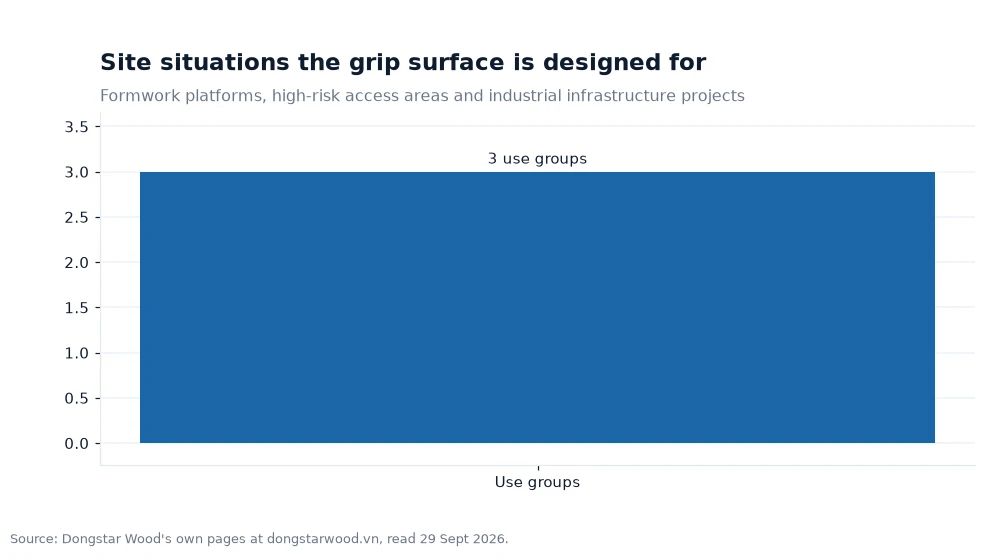
Where it earns its keep is high-rise shuttering, bridge deck construction and industrial concrete slab formwork, where access is continuous and a slip carries real consequences. On a low, single-pour foundation it adds cost without changing the outcome — the honest test is whether anyone walks on the panel at height.
| Specification | Published options | Chosen by |
|---|---|---|
| Surface | Textured hexagonal film | Grip requirement on the working face |
| Sides | Single-sided or double-sided | Whether the reverse face is poured against |
| Thickness | 9 mm to 21 mm | Load and reach of the formwork |
| Adhesive | WBP (Phenolic), melamine, E1/E0 | Water exposure and emission class |
Adhesive and emission choices
Three adhesive routes are published for this range: WBP (Phenolic), melamine and the E1/E0 systems. WBP is the boiling-water-resistant class that outdoor and repeated-use formwork is normally built on; melamine is the economical bond used where the panel will not be repeatedly soaked; E1 and E0 describe emission performance rather than water resistance.
The distinction matters on a mixed order. If some panels are going onto a slab that will be flooded for curing and others into an interior fit-out, quoting one adhesive across both either wastes money or leaves the wet panels under-specified. Name the exposure, not the product family, on the enquiry.
Single-sided or double-sided film
A single-sided panel carries the texture on one face and a smooth reverse, which is what most wall and deck formwork asks for. The double-sided version puts the grip surface on both faces, and it is the sensible choice where panels are turned between pours or where the back of the formwork is itself an access platform.
Manufacturing tolerances matter more on textured panels than on smooth ones, because a worn patch shows up as a difference in grip rather than as a mark on the concrete. When a batch arrives, check the pattern across the middle of the sheets as well as the edges, where handling during transport does most of its damage.
Order the version that matches how the panel will be handled. A double-sided panel that is never turned is paying for a surface nobody touches, while a single-sided panel used upside down on a raised platform is the wrong board in the wrong place.
Formats and thickness for load and reach
The standard sheet is 1220 × 2440 mm; larger formats of 1250 × 2500 mm and 1500 × 3000 mm are also published, alongside bespoke sizes to 1830 × 3830 mm. Thickness is offered from 9 mm to 21 mm so the same surface can be specified on light temporary flooring and on heavy formwork without changing supplier.
Reuse planning is where the texture slows a buyer down in a useful way. A smooth panel can look serviceable long after its face has lost the release quality that matters, while a textured one visibly flattens where it has been walked on most. That wear pattern is a retirement signal for access work: move the flattened sheets to pours where nobody climbs on the deck, and keep the sharpest ones on the platforms.
Edges are sealed as part of the specification, and the published guidance is that multiple reuse cycles depend on proper edge and surface maintenance. That is the same discipline as any film faced panel: seal what you cut, clean what you pour against, and stack flat between cycles.
Worked example: panels behind a walkboard run
Grip panels are usually counted along the route rather than across the soffit, so start with the sheet area. A 1500 × 3000 mm panel gives 1.5 × 3.0 = 4.5 m², and the standard sheet of 1220 × 2440 mm works out at about 2.98 m² (1.22 × 2.44).
An access route 1.2 m wide and 180 m long covers 1.2 m × 180 m = 216 m² (example). Using the standard format, that is 216 ÷ 2.98 = 72.5, so 73 sheets (example). Switching to 1500 × 3000 mm reduces the count to 216 ÷ 4.5 = 48 sheets (example) and also cuts the number of sealed joints the site has to maintain.
Frequently asked questions
Is a grip panel suitable for a standard wall pour?
It works, but the texture is unnecessary unless the formwork is also accessed at height. For plain wall shuttering, a smooth film face gives a cleaner concrete finish and costs less per sheet, leaving the textured panel for decks, platforms and walkways.
What does the hexagonal pattern do to the concrete surface?
It transfers to the face that is poured against. Where the concrete will be visible, keep the textured side facing the access route and the smooth reverse against the pour, which is exactly what the single-sided version is designed for.
How many times can a grip panel be reused?
The manufacturer states multiple reuse cycles with proper edge and surface maintenance, which in practice means sealed edges, a clean face between pours and flat storage. Wear shows on the texture first, and that is the point to retire the panel from access work.
Where to compare the alternatives
The grip panel is one option in a wider set. The structural sheathing range covers the temporary works around the formwork — hoarding, crating and subfloors — while the smooth film faced catalogue is the comparison point for the panels the concrete is actually poured against.
Panel specifications are from the factory's own website, viewed on 29 Sept 2026 for the data in these notes for the data in these notes as the basis for this article[1].